Architecture · 13 min read
Art Deco London
How a Paris exhibition, an ocean liner and one difficult English designer gave London's hotels their geometry.
How a Paris exhibition, an ocean liner and one difficult English designer gave London's hotels their geometry.
The style we now call Art Deco arrived in Britain with the 1925 Exposition Internationale des Arts Décoratifs et Industriels Modernes in Paris. Britain sent a delegation, and the delegation came back convinced. But what London built afterwards was not French Deco. It was cooler, greyer, more restrained — a version filtered through English reticence, ocean-liner engineering and a native taste for good joinery.
The hotels were where this happened most visibly, because the hotels had both the money and the motive. By the mid-1920s a generation of guests who had crossed the Atlantic on the Mauretania and would soon cross on the Queen Mary expected interiors that felt modern, sleek and transatlantic. Edwardian swags looked like their parents' taste.
Basil Ionides is the pivotal figure. In 1929 he remodelled the auditorium of the Savoy Theatre in silver and gold leaf with stepped geometric mouldings — a scheme so striking that it effectively announced Deco to the British public. He carried the same discipline into the hotel next door and, later, into Claridge's.
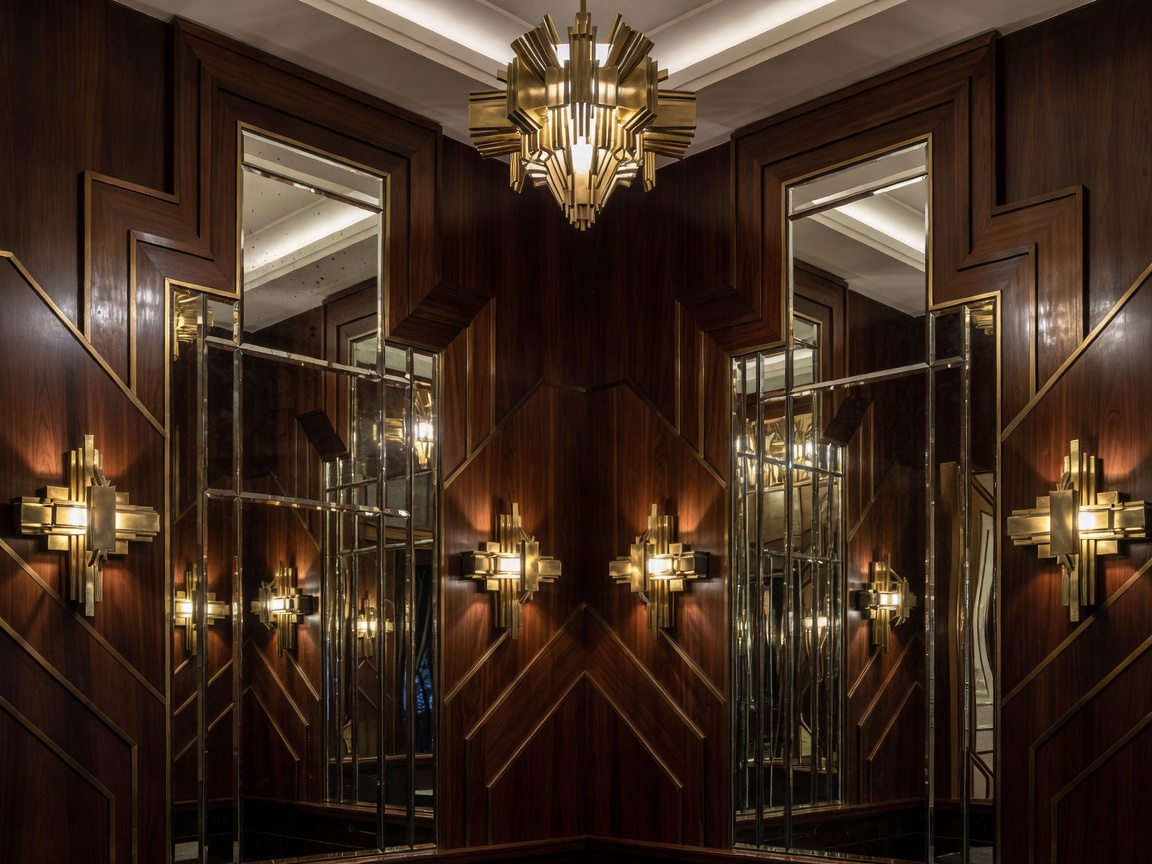
His vocabulary is worth learning, because you will see it everywhere in these five buildings: stepped and fluted plaster mouldings, silvered and gilded surfaces used sparingly against neutral grounds, lacquered black and jade, etched glass, and lighting concealed within architecture rather than hung from it.
Milne remodelled the Claridge's entrance and foyer between 1929 and 1932, adding the porte-cochère and reworking the ground floor in the geometric idiom. The chequerboard floor, the mirrored lift interiors and the stepped detailing around the Reading Room all date from this campaign. Crucially, Milne did not gut the Victorian building; he laid a modern skin over an older structure — the same strategy a hundred hotel renovations have copied since.
Bernard, a theatre designer turned architect, gave the Strand Palace Hotel an illuminated glass entrance hall in 1930 that was so admired the Victoria and Albert Museum dismantled and preserved it when the hotel was modernised in 1969. It is the single best surviving example of British Deco hotel work, and you can still see it in the V&A's British Galleries — free, and ten minutes from Knightsbridge.
The Dorchester came at Deco from the other direction: not decoration first, but structure. Sir Owen Williams's reinforced-concrete frame allowed wide, uninterrupted spans and horizontal ribbon windows — the Promenade is possible only because of the engineering. The later Oliver Messel suites added theatrical plasterwork on top, giving the building two distinct Deco personalities, the engineered and the staged.
"English Deco is Deco with the volume turned down. Silver instead of gold, grey instead of black, restraint instead of spectacle — and it has aged infinitely better for it."
| Motif | What to look for |
|---|---|
| Stepped moulding | Ziggurat profiles on cornices, door surrounds and mirror frames |
| Sunburst | Radiating fans in glass, marquetry and ironwork, usually above doors |
| Chevron & zigzag | Floor inlays and marquetry panelling, often in two contrasting woods |
| Silvered leaf | Ionides's signature; look for it in the Savoy Theatre and Claridge's |
| Concealed lighting | Light sources hidden in coves, throwing illumination up the wall |
| Black lacquer | Furniture and bar fronts, frequently paired with chrome or brass |